
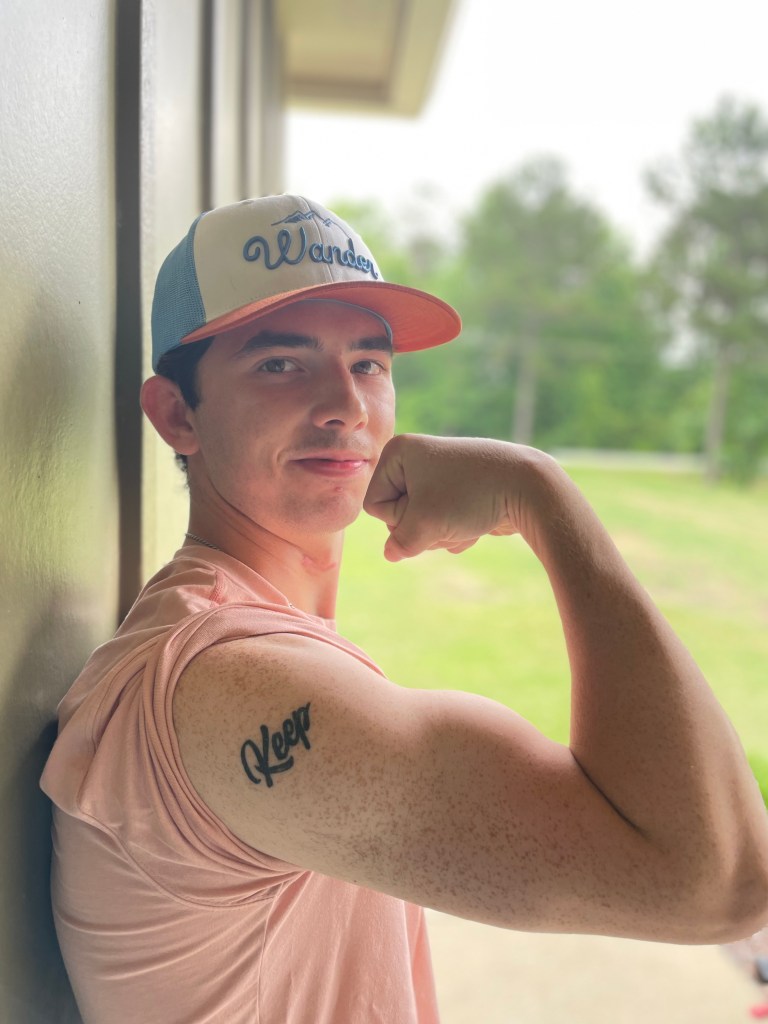
In honor of FA Awareness Month in May, I want to tell you how strong people with FA are. Not “strong” as in emotionally inspiring because of overcoming the hardship of a rare disease. Not “strong” comparatively as in strong for someone with a disability. Not strong because of anything having to do with FA. Just freaking strong.
I get reminded that from time to time. The world assumes I’m physically weak because I use a walker and wheelchair, and sometimes I start to think the same way. Last month during my baseline tests for my new exercise study I’m doing at the University of Florida, I saw just how much my muscles are capable of. I sat with my leg placed in a cast-looking thing, padded on each side, for a strength test called the Biodex. On cue, I pushed and then pulled – calling my quads then hammys into action – with every fiber of strength in me as the two trial coordinators screamed like coaches for me to keep going. Meanwhile, I can see a red line that measures the force of my push reach higher each time I did it until it peaked on my third try going both ways. I felt like my leg was going to burst through the cast at any moment like Superman bursting through a door. And that’s my legs, which are the most affected by muscular atrophy from FA. I can only imagine how high the red line would go if I could use my arms.
But you know what they say: “No pain, no gain.” That saying might sound silly, but it hits home for me.
There’s a lot of good and bad to life with FA. In my last post and others, I talked about how FA has helped shape my perspective and taught me to look past the negatives and recognize the blessings in my life. Well, that remains true as ever, but for FA Awareness Month I want to share a dark time in my life that I’ve never opened up about before. I genuinely would not be the strong man I am today without the years of 8th grade through high school, but I would never wish them on my worst enemy. It was a period where my FA symptoms onset, but no one else knew what was happening and neither did I.
In 9th grade, my FA symptoms became obvious for the first time. At the Smiths Station Freshman Center, there were plenty of opportunities for my symptoms to be seen by others – not just felt by me. I walked up a set of stairs with a full backpack (must’ve been like 50 pounds) on my back each morning to get to my building and had to climb two more flights of stairs to get to my first class. I was an office aid for 2nd period, so I walked all around the school – often carrying packages – going up and down the stairs even more throughout the day, often with another student walking on my heels prompting me to hurry up. I vividly remember carrying a big package through the hallway, while a group that was working outside their classroom stared and chuckled amongst themselves. One of them spoke up: “Why are you walking like that?” That was my first obvious confirmation that people could see what I was feeling.
People could see it, and they used it – whatever “it” was – for their amusement.
Later that school year on the walk back from lunch, a group of boys huddled behind me silently while I was talking to my friend. One came up and tapped me on the left shoulder while another pushed me from my right. The boy who had tapped my shoulder stuck out his leg to trip me, everyone laughing while I went crashing to the concrete. I stood up quickly so no one would see and walked briskly with my head down to class – too embarrassed to keep talking to my friend or to even look anyone in the eye.
This was the start of a game. It was obvious that even a slight shove rocked me like a hurricane throwing a tree. After that little trick, one kid in particular – not big or athletic – would get a good laugh out of coming out of nowhere and shoving me to see how far I’d go backward. It was a game that could happen at any given moment, and I never retaliated or hit back. I was too embarrassed to do anything but speed away from the scene, and I became anxious, ashamed and paranoid as a result.
That wasn’t the first time I had been taken advantage of, either. In 8th grade P.E., my FA symptoms weren’t obvious yet, but my athletic abilities were definitely declining and that was obvious. A lot of people in that class liked me and were some of my best friends, but there were a few of the “cool kids” who enjoyed making others miserable. They saw my athletic weakness and saw ammunition to attack. They did all they could to embarrass me – right in front of my friends. We played tackle football (our teacher was oblivious to all of this, probably napping in his chair) and they’d purposely seek me out and do dirty hits on me. They tripped me, mocked me and kicked me out of their games. I loved sports and sometimes shut them up with a good play, and my friends wanted me in the game, but no one was willing to stand up to the guys who picked on me. I can’t even believe I’m writing this, but they even pantsed me two or three times in front of the whole class, which was all boys, but still it was humiliating.
I had enough after 9th grade. I was scared, confused and I wanted it all to go away. I told my parents I needed to transfer to Glenwood (a private school in the same city), although I listed every reason other than what I’ve written above. I had previously tried out for baseball the last two years at Smiths Station and didn’t make the team (more ammunition for the bullies to mess with me), and I had seen my best friend play baseball at Glenwood. Through him, I made friends there, met girls, and connected with the baseball coaches – they all liked me and wanted me there. By God’s grace, I did move there for my sophomore year, and I was treated so much better. I had a great group of friends, and even the ones I wasn’t friends with back then, I am cool with now.
I love Glenwood and the way they supported me after my diagnosis at the end of my junior year. But although I never received any physical bullying like I did at Smiths Station, there was verbal and emotional stones thrown at me prior to my diagnosis. My symptoms developed even more in my sophomore year, and I developed anxiety from my past experiences.
And my health problems didn’t go away at Glenwood; they got worse. Again, as young high schoolers, others didn’t know what was happening to me and neither did I. What they did know is I had a raspy, quiet voice. I zig-zagged as I walked down the hallway, and I was too shy to talk to people outside of my friend group. Those girls that I met before I came there became strangers once they saw what was happening to me, and people repeatedly mocked my voice. At one point, some of the seniors called me a transformer and that caught fire among my classmates. Of course, I was immature too and didn’t help my own cause by running my mouth and doing stupid things, but I didn’t know what to do to fit in.
One day early in my junior year, I was walking out the back door to go to the baseball field for sixth period when I heard someone call out: “Yo! You walk like you got something stuck up your butt!” Embarrassed once again, I quickly scanned my surroundings to see if anyone else heard. Thankfully, just one guy did, and he held back a laugh and said “you’re wrong for that man.” Again, it was a reminder that this wasn’t going away. People could see “it.”
When people starting messing with me in 8th grade, I realized I should start lifting weights. Maybe if I’m big and strong they won’t mess with me. I also thought getting stronger would help me get better at sports so I could make the baseball team. That didn’t work out, but it has paid huge dividends for me even now. I did get a lot stronger in that time, and having extra muscle is crucial to fighting a neuromuscular disease. My dad helped me start lifting weights, and I got my own bench press set and dumbbells. Again, my dad had no idea of my true motive in lifting – he thought I just wanted to get stronger for sports, and it wasn’t odd for a 14-year-old to take an interest in working out.
I was devoted to offseason baseball workouts at Glenwood. Every one of the coaches helped me and encouraged me a ton. Coach Tim Fanning and Coach Phil Stillwell deserve the world for the way they treated me – not even knowing what was going on with me because I never once brought it up. To this day, I follow their ab circuit workout along with the old saying: “If you gotta rest, bring ’em to your chest.” They helped instill discipline in me, and I had a perfect attendance in “optional” offseason workouts in my sophomore year. Even though I never played a game for them, the lessons I learned in those workouts will serve me for the rest of my life. And even though you could tell, at times, that my balance and coordination weren’t good, my teammates never once made fun of me. The older guys, especially Brandon Moseley and Daniel Holley, helped set an example for me and encouraged me, and I still love those guys to this day. They REALLY wanted to see me play; they are heroes if you want my opinion.
Even leading up to my senior year, I could still throw heat. I’ve always had an abnormally good arm for my size (just like Daniel Holley). I was convinced I could pitch one more time, even if it was just for an inning, because I knew it was my last chance. Those two guys met with me at the Glenwood baseball field two years after they graduated, in the heat of summer, to mentor me and to catch for me. I was still relatively able-bodied up to that point, and I threw pretty well. But I could not run, I could not field my position and I could not back up throws at the bags, as a pitcher must.
When the school year rolled around and workouts began, I was convinced I was going to play, and the coaches knew little about FA and were willing to let me try. I knocked out arm day the first Monday like nobody’s business. On leg day the next day, I stood under the bar with plates on each end and lifted it off the rack on my shoulders with my workout buddies looking on. I stepped back to the center of the rack and my leg immediately gave out. The bar crashed to the safe guards and I stood back up, rattled and shocked at my fall. My teammates put the bar back on the rack and asked if I wanted to try again or put on less weight. “I just need a minute,” I said and stumbled out the front doors. I stood out there, contemplating. I wanted to go back in and finish the workout, but I knew I couldn’t do the weighted squats. I was too humiliated to go back in without finishing the workout like everyone else, and I didn’t want anyone to see me out there. So I got in my truck and drove home – kicking myself for being a “quitter.” Just like the two years prior, my attempt to play the sport I loved was squashed.
My coaches wanted me around and admired my commitment, so they asked me to be a team manager. It broke my heart that I never truly played high school baseball, but after some thought, I accepted and continued to attend games and practices and hang with the team. From start to finish, high school never went to plan, but it all built my character and prepared me for whatever I was to face going forward.
When people tell me “Wow, you’re so strong” or “You’re an inspiration,” I don’t think they truly realize how strong I am – not just because I live life despite a disability, but because I took those repeated hits and chose to get back up and keep going. Unless you saw the years that broke me, you won’t realize just how unbreakable I am now because of it. Like I mentioned, it’s not just mental toughness or overcoming a disability, it’s true grit, it’s muscle and it’s using that muscle for good.
As I do things like the Biodex exercise now, I can’t help but flash back in my mind to those times where that strength first found its power. That’s how I know with certainty, if a cure was to come for FA and I was in sports again, there’s not a single person who could stop me. I don’t mean for that to sound conceited, but it’s 100% true. And I imagine it’s true in one way or another for everyone with FA. Even if a cure doesn’t come in this lifetime, I believe when things are made new in heaven, it’s going to be beautiful and our strength is going to be the thing that’s obvious about us in order to further glorify God.
I also want it to be known that I hold nothing against anyone who said or did anything to hurt me during this time. We were all just kids and didn’t know the severity of what I was dealing with or even that I was dealing with disease onset. I encourage those people to forgive yourselves as I have forgiven you; I know if we all had knowledge of what was happening to me, things would’ve been different and people would’ve been kinder.
People change, circumstances change, but God held me steady through it all. It just goes to show, what doesn’t kill you makes you stronger.


 Knowin' Noah
Leave a reply to Tiffany Sippel Cancel reply